
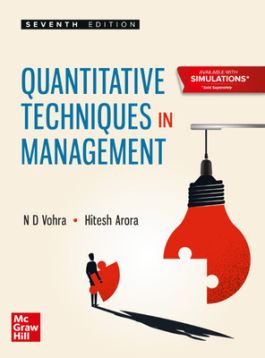
Quantitative Techniques in Management
7th Edition
9364446275
·
9789364446273
© 2026 | Published: May 27, 2026
About the Book:This textbook provides a comprehensive, application-oriented understanding of quantitative tools essential for analytical evaluation and managerial decision-making. It bridges classical Operations Research and Management Science models…
Read More
1. Decision-Making and Quantitative Techniques
2. Linear Programming (I): Formulation and Graphic Solution
3. Linear Programming II: Simplex Method
4. Linear Programming III: Duality and Sensitivity Analysis
5. Specially Structured Linear Programmes I: Transportation and Transhipment Problems
6. Specially Structured Linear Programmes II: Assignment Problem
7. Integer Programming
8. Goal Programming
9. Theory of Games
10. Sequencing
11. Inventory Management
12. Queuing Theory
13. PERT and CPM
14. Simulation
15. Decision Theory
Appendix A: Statistical and Other Tables
Appendix B: Answers to Practical Problems
Bibliography
Index
2. Linear Programming (I): Formulation and Graphic Solution
3. Linear Programming II: Simplex Method
4. Linear Programming III: Duality and Sensitivity Analysis
5. Specially Structured Linear Programmes I: Transportation and Transhipment Problems
6. Specially Structured Linear Programmes II: Assignment Problem
7. Integer Programming
8. Goal Programming
9. Theory of Games
10. Sequencing
11. Inventory Management
12. Queuing Theory
13. PERT and CPM
14. Simulation
15. Decision Theory
Appendix A: Statistical and Other Tables
Appendix B: Answers to Practical Problems
Bibliography
Index
About the Book:
This textbook provides a comprehensive, application-oriented understanding of quantitative tools essential for analytical evaluation and managerial decision-making. It bridges classical Operations Research and Management Science models with emerging applications in the digital economy and sustainability-driven business practices. The text serves as an indispensable resource for students of MBA, PGDM, BBA, and specialized Management Science programs.
Key Features:
• Strengthened focus on the digital economy by linking OR/MS models with contemporary applications, including E-commerce logistics and supply chain digitization.
• Introduction of Machine Learning (ML) fundamentals within Decision Theory, enabling readers to connect analytical models with modern data-driven decision-making.
• Extensively revised Goal Programming chapter with expanded coverage of AHP, multi-criteria decision-making, and sustainability-oriented applications such as ESG and carbon footprint analysis.
• Inclusion of five new real-world case studies across key chapters to align concepts with current business challenges and industry practices.
This textbook provides a comprehensive, application-oriented understanding of quantitative tools essential for analytical evaluation and managerial decision-making. It bridges classical Operations Research and Management Science models with emerging applications in the digital economy and sustainability-driven business practices. The text serves as an indispensable resource for students of MBA, PGDM, BBA, and specialized Management Science programs.
Key Features:
• Strengthened focus on the digital economy by linking OR/MS models with contemporary applications, including E-commerce logistics and supply chain digitization.
• Introduction of Machine Learning (ML) fundamentals within Decision Theory, enabling readers to connect analytical models with modern data-driven decision-making.
• Extensively revised Goal Programming chapter with expanded coverage of AHP, multi-criteria decision-making, and sustainability-oriented applications such as ESG and carbon footprint analysis.
• Inclusion of five new real-world case studies across key chapters to align concepts with current business challenges and industry practices.